Resources: Observation Request Form, Stellarium Web, SIMBAD, NASA, Sky & Telescope, Wolfram Alpha
Researching Your Object
Before making your final selection, be sure to review the Project Description document on the Final Observing Project page. Please note that you will need to be able to produce a tri-color image of the object you select, and perform a calculation based on the data.
Once you have selected your object, it is time to do some research on it! Using a combination of Stellarium, and other resources, you will need to determine what type of object you are attempting to observe, and list three facts about that type of object.
Note: Wikipedia is not considered a credible source for research, though we recommend looking through their article citations to find other sources. Good sources for your project may include (though are certainly not limited to): SIMBAD, NASA, and Sky & Telescope.
Selecting Your Filters
After you have selected your observation target, you will need to prepare your observing request. Your observing request needs to contain 3 filters, with an exposure time listed for each one. Please note that the exposure time does not have to be the same for each filter and in many cases, should be different!
Available filters for this project include the following:
| Broadband Filters | Narrowband Filters |
g, r, i (green, red, infrared) | SI, Hα, OIII (Sulfur, Hydrogen Alpha, Oxygen) |
Generally speaking, broadband filters allow in a large portion of light and are usually best for objects such as star clusters and galaxies. Meanwhile, narrowband filters let in just a small portion of the spectrum, centered around an emission line (think of the elemental lamps from the Spectroscopy lab). These are generally a good choice for nebulae, as they tend to be dominated by ionized gases which emit strongly at specific wavelengths. However, narrowband filters, and Hα in particular, can also be a nice supplement to broadband filters when imaging galaxies, as it can help highlight star-forming regions within the galaxy.
For your project, you may choose to use all broadband filters, all narrowband, or a mix of the two for your image, though you should be prepared to justify the filters you choose based on the object type and what you hope to learn.
Exposure Time Examples for RLMT
See the guide below to select an appropriate exposure time for each of your three filters.
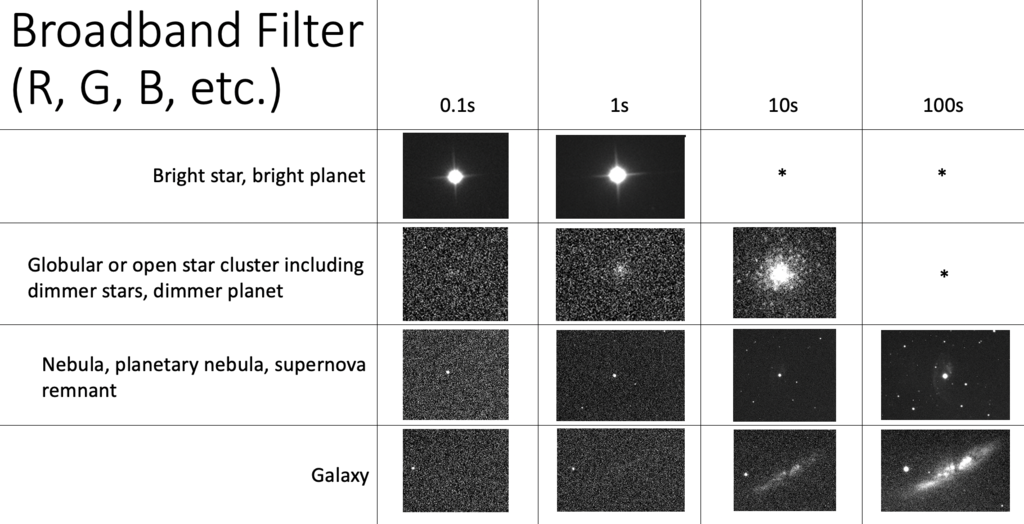
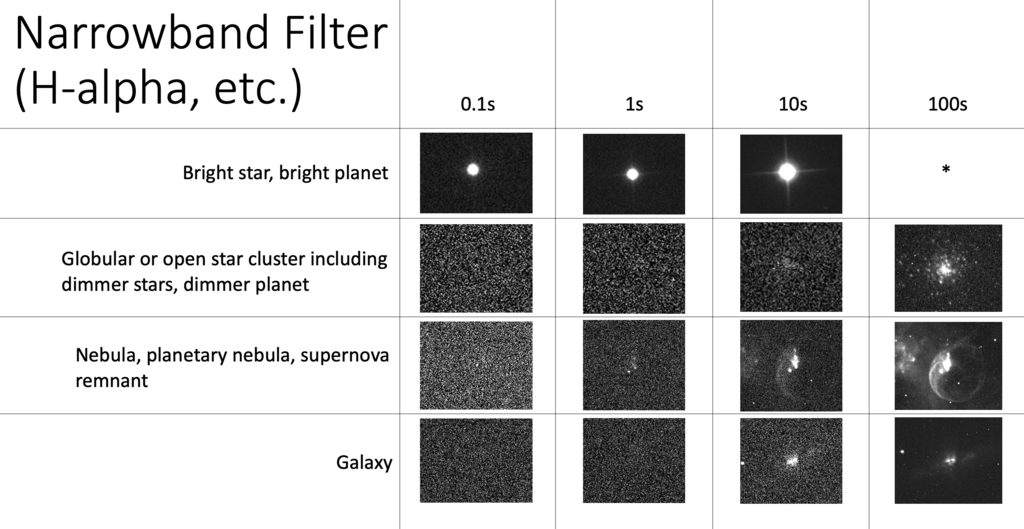
* A longer exposure time will saturate the camera and should not be attempted (the camera will have reached its maximum recording ability and more light collection will not improve the image)
Submitting Your Observation Request
Once you have finalized your observation request, you must submit it via this Microsoft Form before leaving lab. It is highly recommended that you check in with your TA during this step, in case you have any issues.